B2B ordering: from quote to invoice, in Greek and English
How a wholesale or B2B business runs the flow from quote to order, delivery note and invoice — and what changes when the customer is abroad.
In retail, a sale is a moment: the customer pays and leaves. In wholesale and B2B, a sale is a sequence: quote, order, shipment, invoice, payment — often with weeks between the first step and the last, and more than one person touching the same transaction.
When each step lives in a different file — the quote in Word, the order in an email, the delivery note in the warehouse notepad, the invoice in the invoicing software — the same data gets typed three or four times. And every retyping is a chance for a mistake: the wrong price, a forgotten discount, an item invoiced that never left. This article walks through how to set the flow up properly, step by step — and what changes when the customer is abroad and the documents have to be in English.
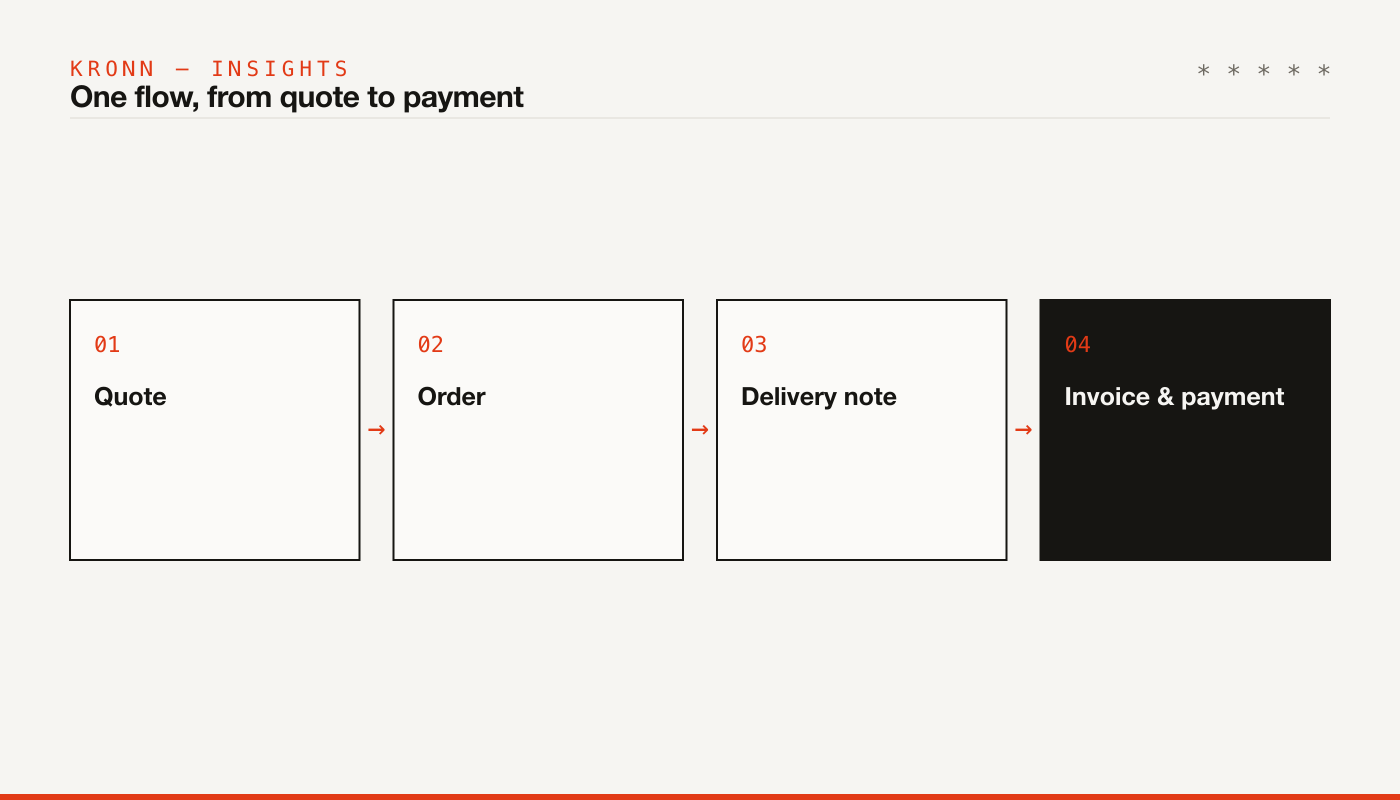
The flow matters more than any single document
The core idea is simple: the transaction is written once and carried forward. The quote becomes an order, the order becomes a delivery note, the delivery note becomes an invoice — and at every step everything set at the previous one follows automatically:
- Customer, delivery address, payment terms.
- Items, quantities, prices, discounts, VAT.
- Notes and special arrangements.
- The language of the documents.
Every document knows where it came from. From the invoice you can see the delivery note, from the note the order, from the order the quote. When the customer asks “why was I charged this price?”, the answer is two clicks away.
1. The quote: the price that applies to this customer
In wholesale there’s rarely one price. There’s the base price list, price lists per customer category (shops, restaurants, distributors, say) and the special prices agreed with specific customers. A good quote starts with the right price already filled in — not with the sales rep digging through email for what was agreed.
What a quote needs:
- Validity: how long you’re committed.
- A PDF in the customer’s language, with your company’s details.
- Status: sent, accepted, rejected — so you know what’s pending.
- Conversion without retyping: when the customer says “yes”, the quote becomes an order (or straight away an invoice) with one button — and is marked as converted, so it can’t be converted a second time by mistake or by a double click.
2. The order: what you promised
The order is your commitment to the customer. Before confirming it, two checks save a lot of trouble:
- Availability: are the goods there, or already reserved for another order? Is anything on its way from a supplier?
- Credit limit: does the customer have overdue invoices or exceed the limit you’ve given them? Better to know before you load the truck.
In practice many orders are fulfilled in part: you ship what you have and the rest stays on back order until it arrives. The system has to remember what’s missing, without relying on anyone’s memory. And if you run a B2B online shop, its orders should land in the same list as the ones your sales reps take — not in a second system someone copies from.
3. The delivery note: the goods leave
When goods leave, a delivery note is issued and stock goes down. In Greece, digital issuance of movement documents has been mandatory since 1/12/2025 (phase A of the digital delivery note): the note is transmitted to myDATA and the recipient is notified. Phase B — loading, transshipment, receipt — starts on 1/1/2027, according to AADE’s announcement of 30/9/2026.
Alternatively, when you invoice at the moment of shipment, a single sales invoice that is also a delivery note covers both. The choice depends on your flow: if you invoice each shipment separately, the combined document is simpler; if you invoice in bulk at the end of the period, you need separate delivery notes.
4. The invoice and the payment
The invoice is issued per shipment, or consolidated for all of a period’s delivery notes, and refers to the notes it covers. For sales to businesses in Greece it’s issued through an e-invoicing provider — mandatory for most businesses from 2/11/2026 (all the dates are in our article on Greek e-invoicing and myDATA).
The critical point here is one rule: invoice only what was delivered. If an item didn’t leave, it doesn’t go on the invoice; it stays on the order. And every delivery note not yet invoiced must show up in a list of “open notes”, because a forgotten note is revenue lost.
Finally, payment. An invoice that reaches the customer by email, with your IBAN and a unique payment code, gets paid more easily — and when the payment arrives, the bank connection matches it on its own.
When the customer is abroad
More and more Greek businesses sell to customers in Cyprus, Bulgaria, Germany or outside the EU. The flow stays the same; three things change.
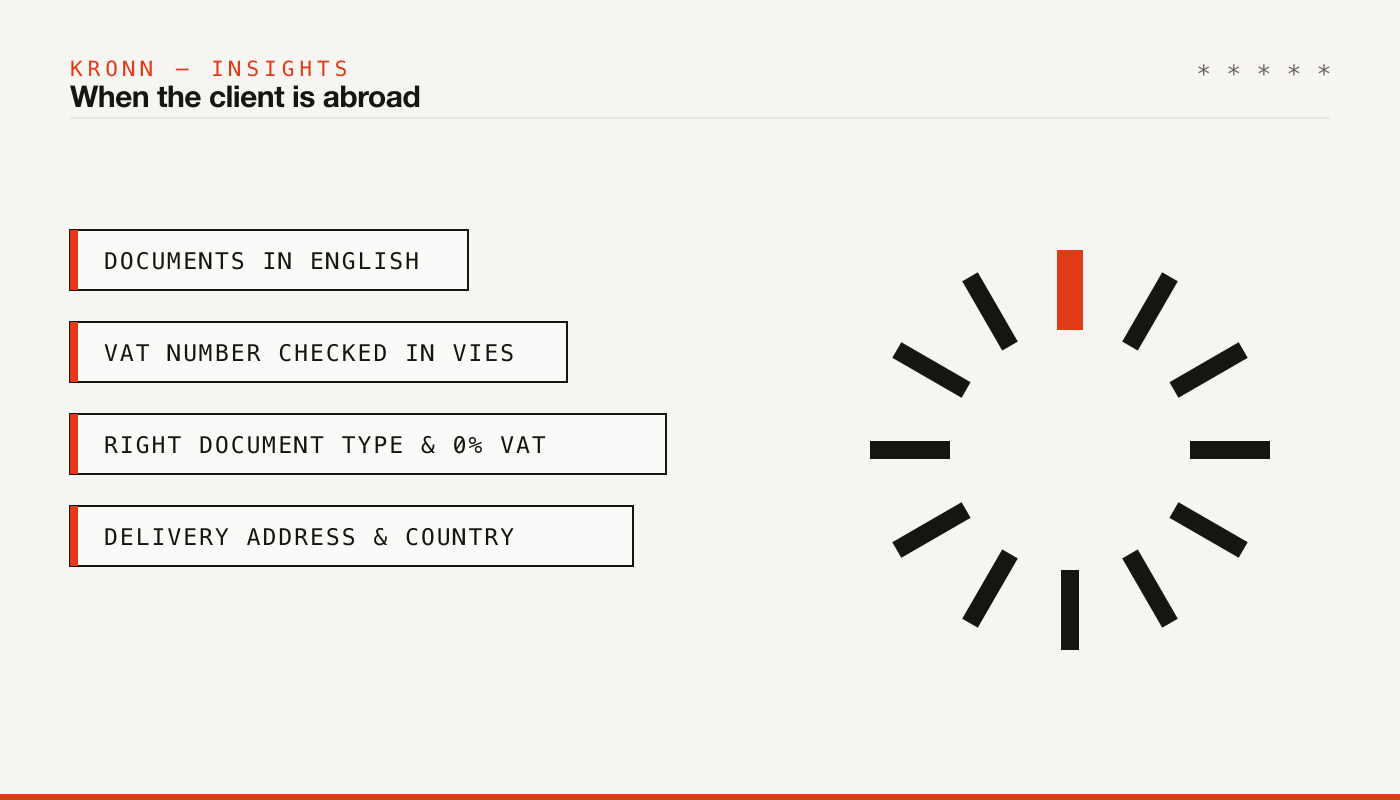
Language. A customer abroad needs the quote, order, delivery note and invoice in English — not a Greek document with a translated title. That means English labels, units, dates, number formats and country names. The language is set once on the customer and follows the whole flow: an English quote becomes an English order, and the invoice that follows comes out in English too.
VAT and document type. For a business customer in another EU country, a sale of goods is as a rule an intra-community supply at 0% VAT, issued with the matching myDATA document type (1.2 for goods, 2.2 for services). The condition is the customer’s valid VAT number, checked in the European Commission’s VIES system — ideally at the moment of issue, not only when the customer was first created. For customers outside the EU the types are 1.3 and 2.3 (third countries). The rules have further conditions — proof that the goods were transported, for example — so check your own cases with your accountant.
E-invoicing. For sales to businesses in other EU countries, issuing an e-invoice through a provider stays optional; for sales to businesses in non-EU countries, it’s part of the obligation. Either way, the customer’s address must be complete, with postcode, city and country.
The usual mistakes
- Prices retyped at every step, with the risk that the invoice doesn’t match the quote.
- A quote converted twice, producing a duplicate order or invoice.
- Invoicing items that weren’t delivered, then credit notes to fix it.
- Delivery notes never invoiced, because nobody sees the open ones.
- English documents with Greek leftovers: units, notes, country names.
- A VAT number never checked in VIES, and an intra-community supply that risks losing its exemption.
The flow in Kronn Smart
In Kronn Smart, the wholesale and B2B pack covers this whole flow: price lists per customer category and special prices per customer, quotes that become orders or invoices, orders with availability and partial fulfilment, credit limits, delivery notes transmitted to myDATA as the goods leave, and invoices per shipment or consolidated, through the built-in e-invoicing provider. Documents come out in Greek or English depending on the customer, and EU customers’ VAT numbers are checked in VIES. Orders from a Magento 2 online shop arrive in the same list as the ones you enter yourself. See also the packs for food suppliers and for retail and wholesale.
If you need a B2B online shop or marketplace for your customers, that’s part of our ecommerce services — see how we did it for hospitality in our article on smart B2B ordering in HoReCa. For everything else, write to us.
Sources
- AADE, press release 30/9/2026 (in Greek): e-invoicing for Period B and phase B of digital movement documents.
- AADE, press release 16/9/2025 (in Greek): sales to EU and non-EU businesses.
- European Commission, VIES: VAT number validation.