Greek e-invoicing and myDATA in 2026: who, what and when
Mandatory B2B e-invoicing in Greece: who it covers, the official dates (2/3/2026, 2/11/2026, 1/2/2027), what changes in myDATA and what to do now.
Mandatory e-invoicing has been the most talked-about tax topic of the year in Greece — and its dates changed twice. If you’ve lost track between “February”, “March”, “1 October” and “2 November”, you’re not alone.
This article sets out what applies today, based on the official decisions and announcements of AADE, the Greek tax authority: what is mandatory, for whom, from when, how you can comply, and what you need to have done before 2 November 2026. Every date comes with its source, listed at the end. Dates are written day/month/year, as in the Greek documents.
Updated with joint decision Α.1197/2026 (Government Gazette Β΄ 5905/30.9.2026). This article is for information and is not tax advice; for your own business, talk to your accountant.
E-invoicing and myDATA: what each one is
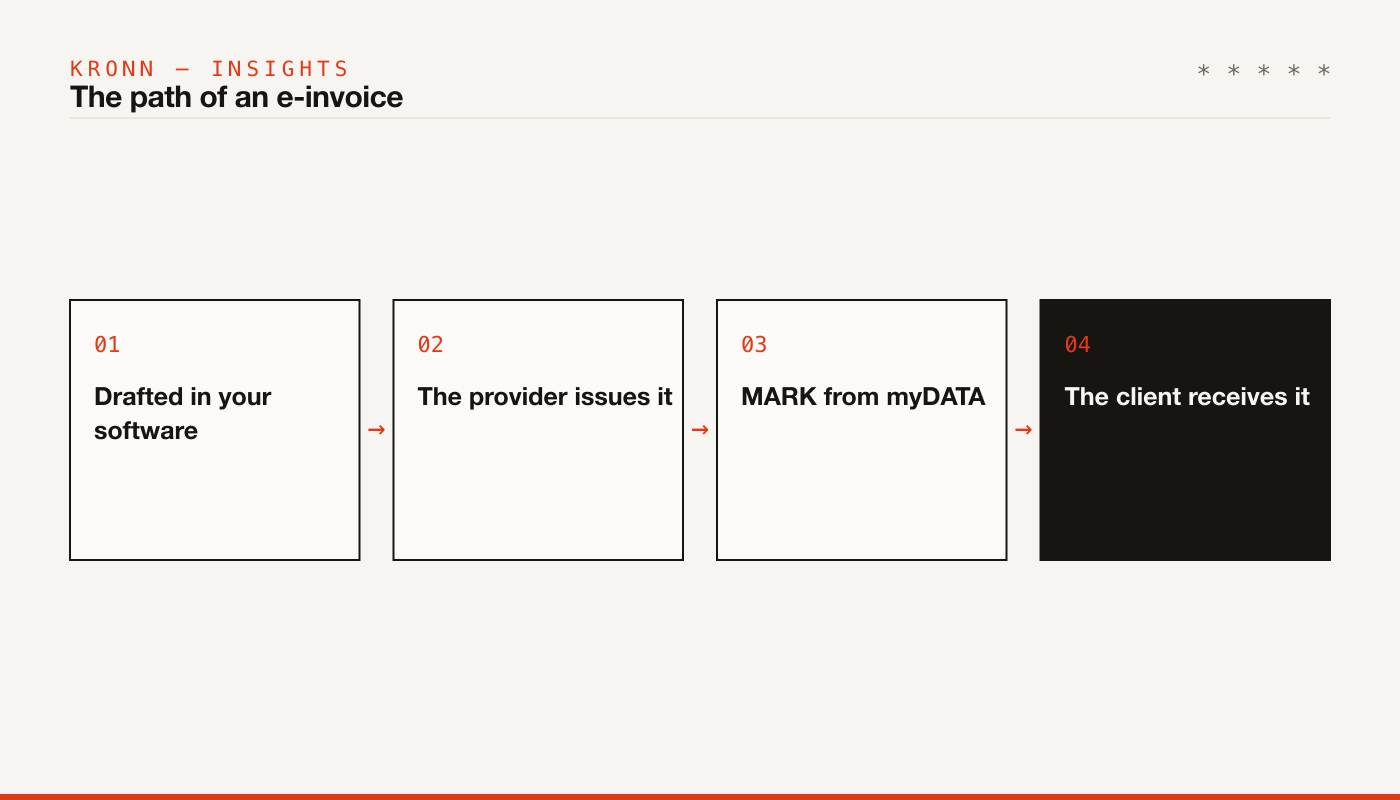
myDATA is AADE’s digital platform where businesses transmit the data of their documents. Every document transmitted gets a unique registration number, the MARK. Until now, many small businesses sent their invoices to myDATA straight from their invoicing software or through AADE’s special entry form.
E-invoicing goes a step further: the invoice is issued electronically through a certified e-invoicing provider (Πάροχος, ΥΠΑΗΕΣ) or through AADE’s free apps, and its data reaches myDATA at the moment of issue. For the transactions the obligation covers, invoicing or accounting software on its own is no longer enough.
Who it covers
Under decision Α.1128/2025 (article 1), electronic invoicing is mandatory for entities that apply the Greek Accounting Standards (Law 4308/2014) in these transactions:
- Sales of goods and services to businesses in Greece (domestic B2B).
- Sales to businesses in non-EU countries (not retail sales).
- Public contracts and General Government expenditure (B2G).
What it does not cover:
- Sales to businesses in other EU member states: issuing them electronically stays optional. If the customer doesn’t accept an e-invoice, you can send it another way.
- Retail sales to consumers (B2C): the obligation concerns invoices between businesses and to the public sector. Retail receipts follow their own rules.
There is also the receiving side. Since 2/3/2026, businesses in Greece must accept the e-invoices other Greek businesses issue to them. There is no such obligation for invoices from businesses abroad.
The two periods and their dates
The obligation applies in two periods, depending on the business’s gross revenue in its income tax return for the tax year that began in 2023.
Period A — gross revenue above €1,000,000. Originally set for 2/2/2026. Decision Α.1044/2026 moved the start to 2/3/2026, with a phase-in period until 3/5/2026. According to AADE, about 34,000 of the 38,000 businesses in this period had already activated e-invoicing by February.
Period B — every other business. Originally set for 1/10/2026. Decision Α.1197/2026 of 30/9/2026 moved the start to 2/11/2026, with a phase-in period until 31/1/2027.
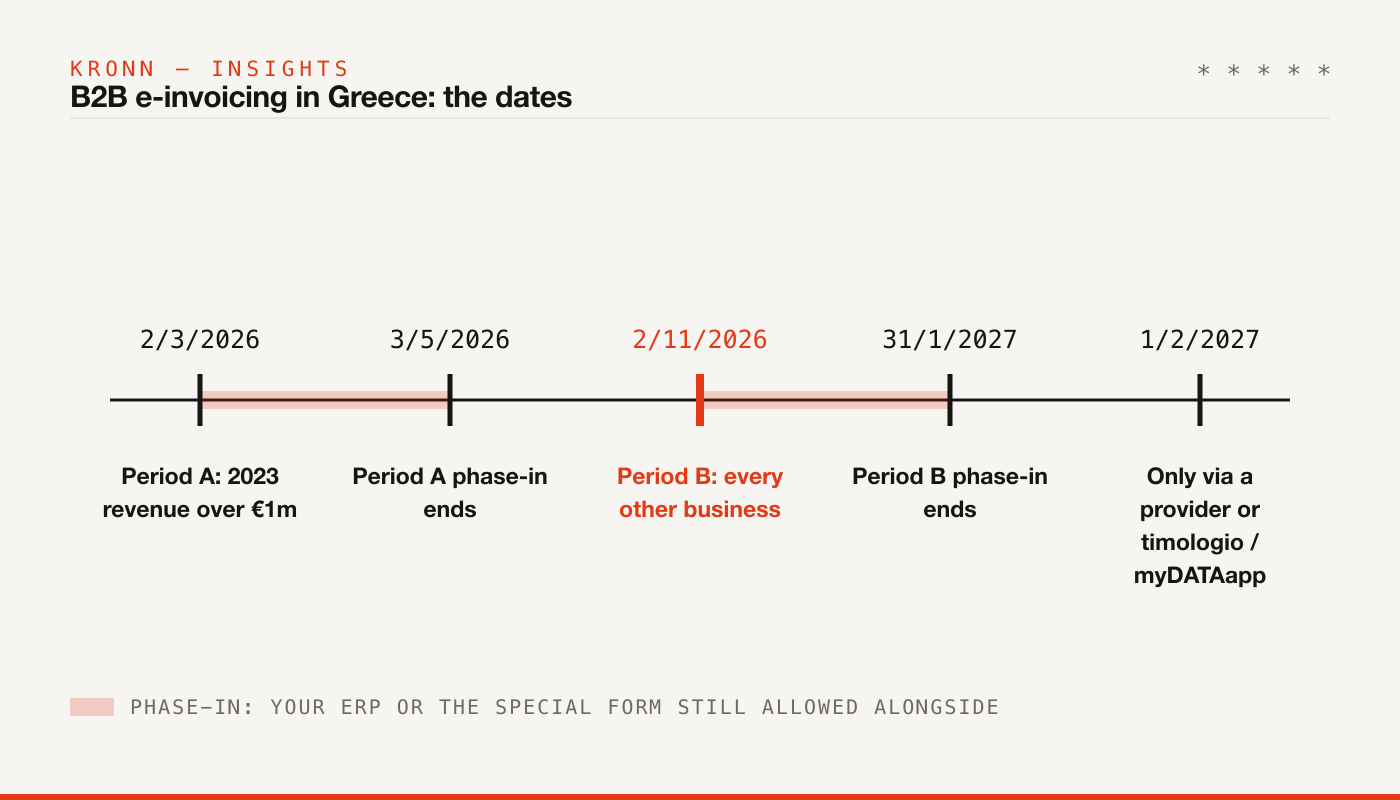
What “phase-in” means. Between 2/11/2026 and 31/1/2027 you can start gradually, still using your invoicing or accounting software (ERP) or the special entry form alongside. The condition is a timely Declaration of Start of Electronic Issuance (Δήλωση Έναρξης Ηλεκτρονικής Έκδοσης Στοιχείων) — or the declaration of use for AADE’s timologio app — with a start date no later than 2/11/2026.
From 1/2/2027 the alternatives end. From that date, domestic B2B, non-EU and public-sector invoices are issued and transmitted to myDATA only through a provider or the timologio and myDATAapp apps. As AADE puts it, transmitting these documents any other way — straight from an ERP, for example — will no longer be possible.
For a sense of scale: in its 30/9/2026 announcement AADE reported that about 655,000 businesses — almost 70% of those potentially in Period B — were already using a provider or its apps for their wholesale transactions.
A provider or AADE’s apps?
You can comply in one of two ways.
1. An e-invoicing provider. The provider connects to the software you already use (or is built into it), issues the invoice and transmits its data to myDATA. Under decision Α.1112/2025 (article 6), the provider files the Declaration of Start in myAADE within 10 days of the contract starting; you accept or reject it within 10 days, otherwise it counts as accepted. If the provider doesn’t file it, you must. Before you start, you give the provider a specific authorisation in Taxisnet.
2. AADE’s free apps: timologio and myDATAapp. They fully meet the obligation, public-contract invoices included. If you issue exclusively through them from 2/11/2026 and don’t need the phase-in period, no Declaration of Start is required.
Which fits? AADE’s apps are enough for a handful of invoices a month. As volume grows, what happens around the invoice starts to matter: whether stock updates, whether you can see who owes you, whether the invoice reaches the customer by email with a payment code, whether you’re typing the same data in two places. That is where software with a built-in provider saves the double work. For the selection criteria, see our guide to choosing an ERP in 2026.
What changes day to day
Data has to be right from the start. The invoice is transmitted the moment it is issued. The customer’s VAT number, name and address must be correct before you press “issue”, not fixed afterwards.
Credit notes follow the same road. A correction is a credit note, also issued electronically and linked to the original document.
The digital delivery note is a separate obligation. If you move goods, digital issuance of movement documents (phase A) has applied since 1/12/2025. Phase B — loading, transshipment, receipt and transmission of quantity-check data — starts on 1/1/2027, and uniform item coding under TARIC on 1/1/2028 (AADE announcement of 30/9/2026). More on delivery notes and stock in our article on suppliers who invoice monthly.
Fines. Under circular Ε.2004/2026, failing to issue an e-invoice where it is mandatory is treated as not issuing the invoice at all. For transactions with VAT, the fine is 50% of the VAT that would have arisen; for transactions without VAT, €500 per tax audit for single-entry books and €1,000 for double-entry books (Code of Tax Procedure, article 57, Law 5104/2024).
Early-adoption incentives. Decision Α.1129/2025 provided enhanced deductions for businesses that moved to e-invoicing two months early — for Period B, AADE’s 16/9/2025 announcement gave a deadline of 3/8/2026. If you think you qualify, check with your accountant.
What comes next: e-invoicing across the EU
Greece isn’t alone. On 11 March 2025 the Council of the EU adopted the ViDA package (VAT in the Digital Age), which brings digital reporting and e-invoicing to cross-border B2B transactions within the EU from 1 July 2030. Sales to EU businesses, optional today, will follow. Getting organised properly now will make that transition far easier.
What to do now: a checklist
- Find your period. Check the gross revenue in your return for tax year 2023. Up to €1,000,000: Period B, starting 2/11/2026.
- Choose how you’ll issue. A provider (standalone or inside the software you use) or the timologio / myDATAapp apps.
- Check the Declaration of Start. If you want the phase-in period, its start date must be 2/11/2026 at the latest. With a provider, accept its declaration in myAADE.
- Clean up your customer data. VAT numbers, addresses, tax offices. Software that fills in details from AADE’s registry by VAT number prevents a lot of errors.
- Run a test before your first real invoice. An invoice, a credit note, an invoice to a non-EU customer — whatever you usually issue.
- Plan for 1/2/2027. If you transmit from your ERP today, that stops for B2B invoices on that date. Solve it now, not at the end of January.
How Kronn Smart covers it
In Kronn Smart the e-invoicing provider is part of the software, in every plan, with no second subscription. Invoices, credit notes and receipts go through the same provider and get their MARK automatically, and customer details are filled in from the VAT number. Delivery notes are transmitted to myDATA as the goods leave. You can try everything in demo mode, where nothing is sent to AADE. Details on the e-invoicing page and the pricing page.
If you’d like to see it with your own documents before 2 November, write to us.
Sources
- AADE, press release 30/9/2026 (in Greek): new deadlines for Period B and phase B of digital movement documents.
- AADE, press release 17/2/2026 (in Greek): Period A postponed; fines (Ε.2004/2026).
- AADE, press release 16/9/2025 (in Greek): scope, intra-EU sales, incentives.
- Decision Α.1128/2025 (Gazette Β΄ 4937/16.9.2025), as amended by Α.1044/2026 (Gazette Β΄ 880/17.2.2026) and Α.1197/2026 (Gazette Β΄ 5905/30.9.2026).
- AADE, decision Α.1112/2025 (Gazette Β΄ 4206/1.8.2025, in Greek), article 6: declarations through a provider.
- Council of the EU, press release 11/3/2025: ViDA package adopted.