AI automation for small businesses: where it actually pays off
Which tasks in a small business are worth automating with AI, where to start, and how to measure whether the effort paid for itself.
AI has become the most talked-about word in technology — and the most abused. For a small or mid-sized business, the question is not “should we add AI?” but “which specific task eats hours every week, and could it run on its own?”. Framed that way, the answers get practical fast.
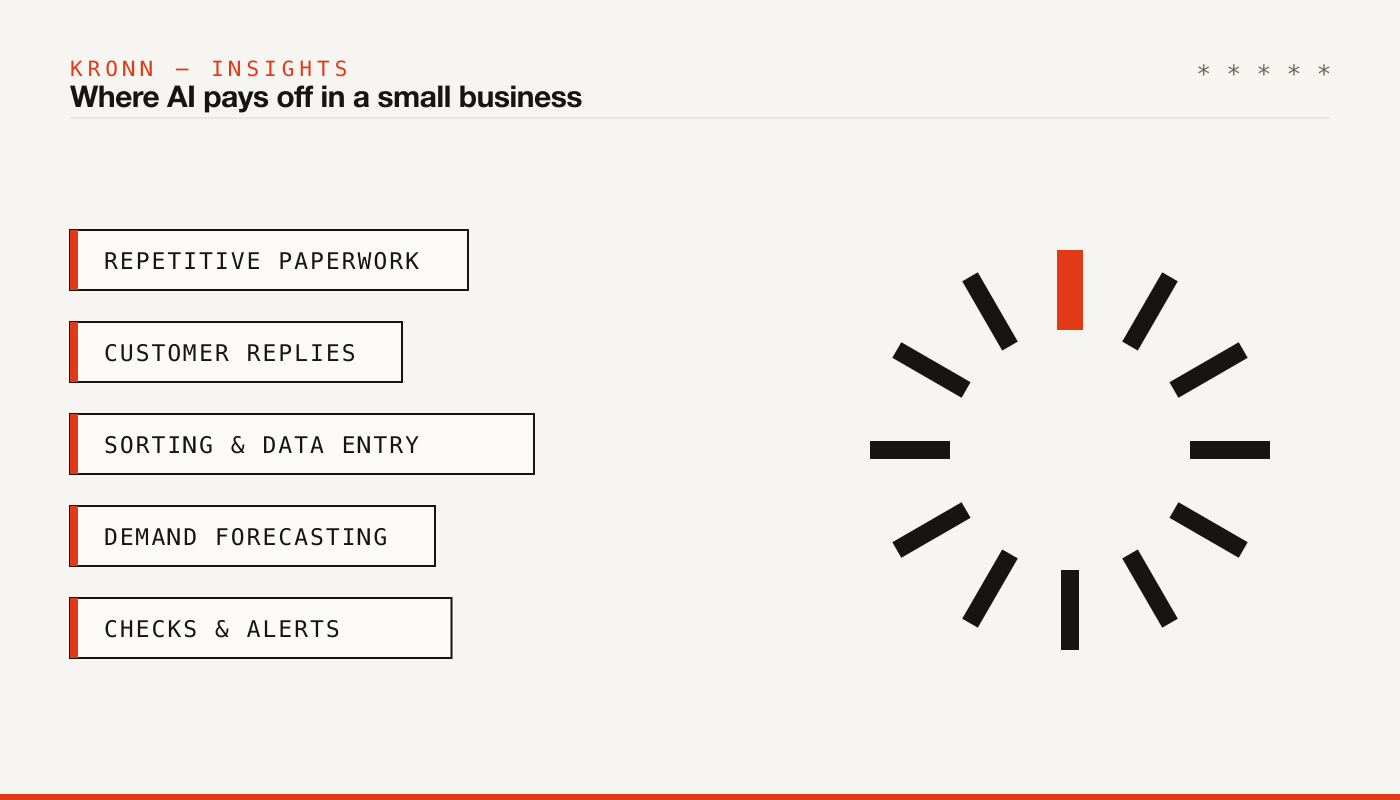
The five zones where AI pays off immediately
Repetitive paperwork. Invoices keyed in by hand, documents copied from email into the accounting system, data re-entered from one tool into another. A model that reads documents does this in seconds, with fewer errors than a tired human at 6 p.m.
First-line customer service. Sixty to seventy percent of the messages a business receives are repeated questions: opening hours, availability, shipping cost, “where is my order”. A well-configured assistant answers those instantly and escalates to a human whatever genuinely needs judgement.
Sorting and entry. Emails routed to the right department, requests that should open a ticket in the right system, documents filed with the right metadata.
Forecasting. Seasonal demand, stock needs, staffing per shift. You don’t need a perfect forecast — you need one better than gut feeling.
Checks and alerts. AI doesn’t sleep: it watches competitor prices, sensor deviations, unusual ordering patterns — and only notifies you when something deserves attention.
How to start without getting burned
The trap is “let’s automate everything”. The right path is humbler and more profitable:
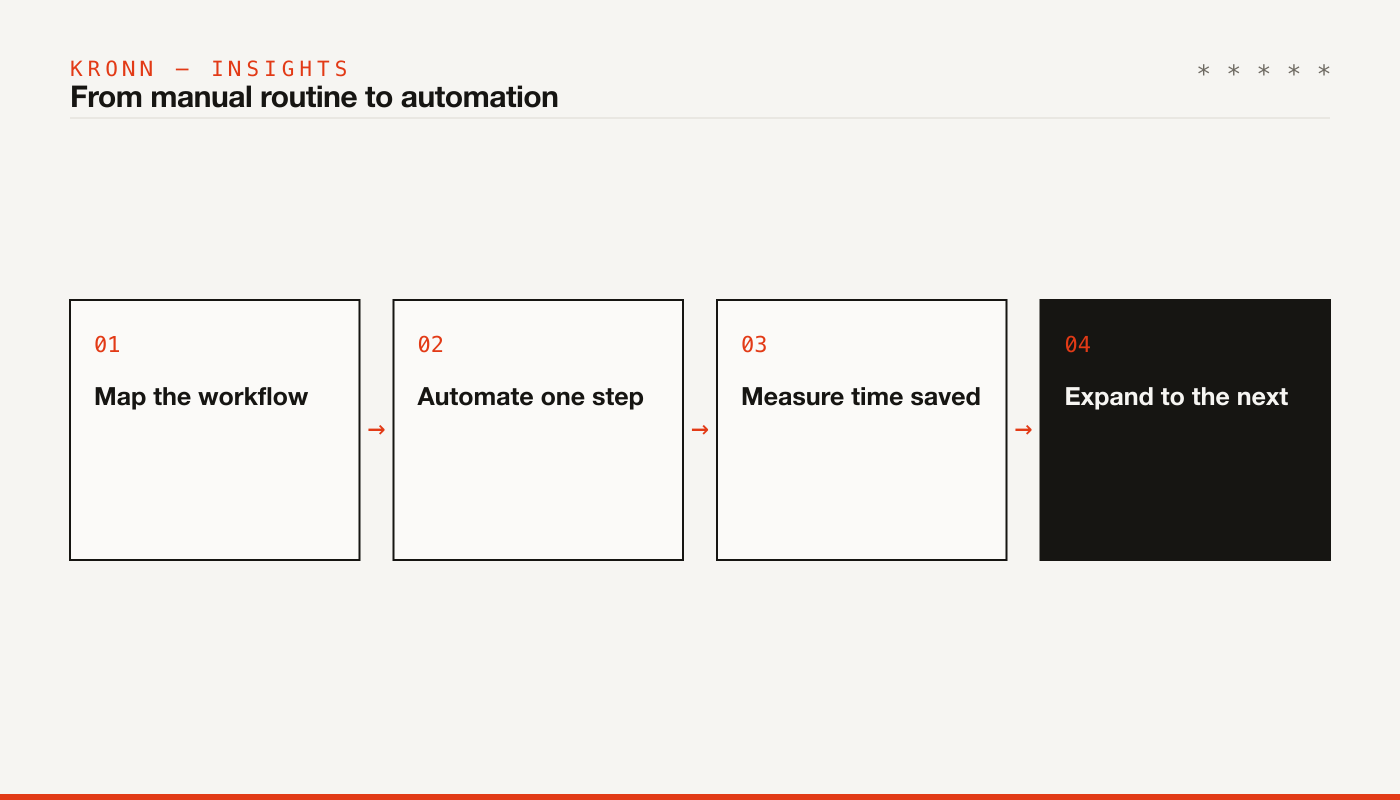
Pick one workflow — ideally the one your team complains about most. Map it into steps. Automate the most repetitive step, not the whole flow. Measure: how many hours saved, how many errors avoided? If the number is convincing, move to the next step. If not, you learned something cheaply.
At Kronn we apply the same logic to our own products: Makker suggests shift schedules from real traffic data, and Xodroulis predicts the next order before the shelf runs empty. We didn’t add AI for the press release — we put it where it saved our customers hours every week.
What to watch out for
Two things separate automation that works from a toy that gets forgotten. First, data: a model that forecasts demand needs sales history in usable form — if everything lives in notebooks, step one is digitisation, not AI. Second, the human in the loop: at critical points (payments, commitments to customers) the automation proposes and a person approves, until trust is earned with a measurable track record.
If you want to see where AI automation would pay off in your own operation, talk to us — or see how we approach custom internal tooling.